The Hidden Spiritual Meanings Behind Iconic Kanchipuram Saree Motifs
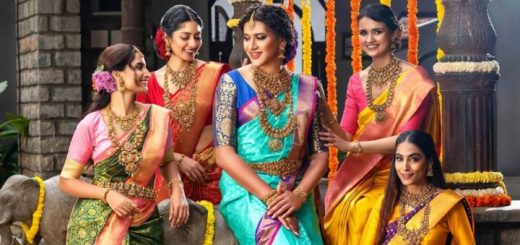
There is a specific, rhythmic clack-clack that echoes through the narrow lanes of Kanchipuram. It’s a sound that hasn’t changed in centuries. If you’ve ever run your fingers over the heavy, textured gold of a real Kanjivaram Saree, you know that feeling. It isn’t just fabric, it’s a weight that feels like history. Lately, I’ve realized that while many of us love wearing these “Queen of Silks,” we’ve lost the ability to actually read them.
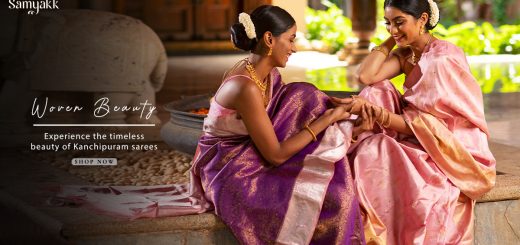
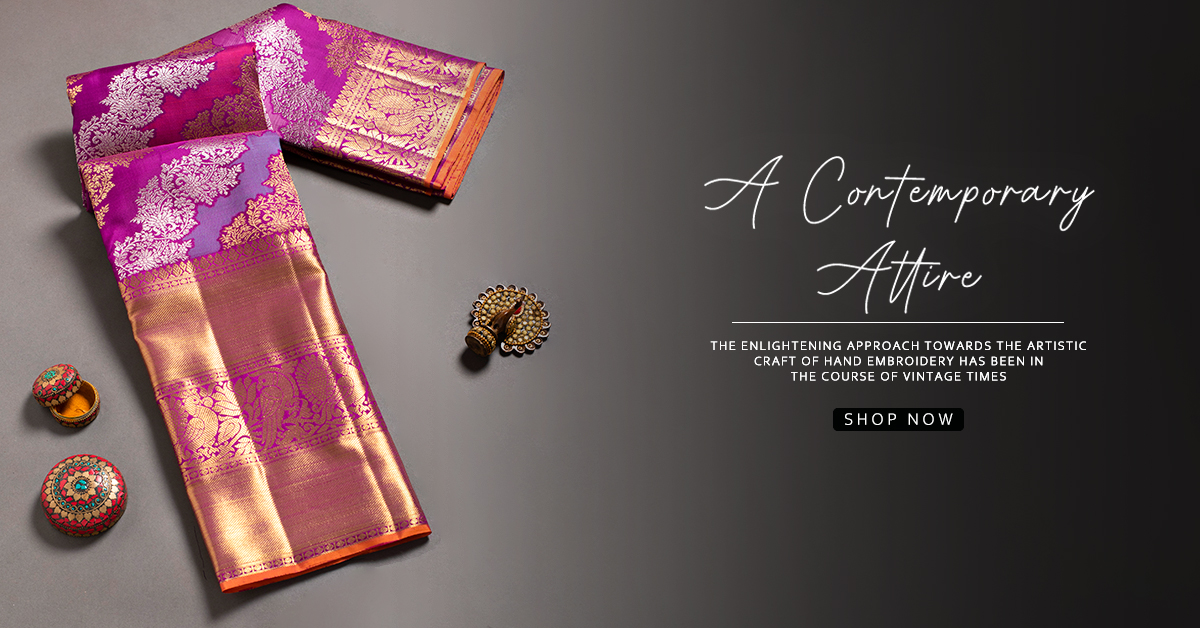
We see a pretty bird or a gold triangle and think “Nice Design,” but in the “Silk City,” weavers don’t really do random patterns. They weave visual prayers. Every motif from the tiny dots on the body to the artwork on the pallu is a piece of a larger spiritual puzzle. To understand a Kanchipuram Silk Saree is to understand the soul of South India. It is a language written in silk, where every thread is a syllable and every border is a story.
Temple (Gopuram) Motif: Divine Architecture on Fabric
If you look at the border of a Traditional Kanchipuram saree, you’ll often see those sharp, jagged rows of triangles. These are a tribute to the city’s skyline. Kanchipuram is home to towering gopurams (temple gateways), and weavers brought that divine protection home through the Korvai technique. This labor-intensive process joins the border and the body manually. When you wear it, you’re literally framed by the architecture of the gods. You can feel the extra thickness at the seam, the physical mark of two worlds meeting.


Mayil (Peacock) Motif: A Symbol of Divine Grace
The peacock is the undisputed celebrity of the Kanjeevaram Saree world. Beyond its beauty, the Mayil is the vahana of Lord Murugan. To a weaver, it represents a spiritual “unfolding”. Just as a peacock spreads its feathers, this motif symbolizes the wearer’s grace and the blossoming of their creative soul. It’s also a lucky charm the “eyes” on the feathers are believed to ward off negativity and the “evil eye”. It says you are seen, protected, and beautiful.


Yanai (Elephant) / Gaja Motif: Strength and Wisdom
The Yanai or Gaja is a sacred symbol linked to Goddess Lakshmi and Lord Ganesha. It’s about more than wealth, it’s about the kind of wisdom that is heavy, quiet, and grounded. When a weaver crafts a row of elephants, they are weaving stability into the silk of the Kanchipuram Saree. It’s a silent wish for a life that has the strength to withstand any obstacle a reminder that true power doesn’t need to shout to be felt.


Annapakshi (Celestial Swan): Purity and Refinement
The Annapakshi is a mythical celestial bird said to have the divine discernment to separate milk from water. In a world that’s often confusing, it serves as a metaphor for the human soul the ability to choose truth and leave falsehoods behind. It’s a motif for someone who values elegance and a refined mind. It suggests that you aren’t just wearing a saree, you are wearing your values.


Mango (Paisley or “Mankolam”) Motif: Fertility and Prosperity
While the rest of the world calls it “paisley” in South India, it’s a Mankolam. This shape represents the fruit of the gods, symbolizing the harvest, fertility, and the “ripeness” of life’s rewards. It’s a celebration of abundance, which is why you’ll rarely find a bridal Kanchipuram Silk Saree without a mango motif woven into its gold zari. It’s a visual blessing for a life that is sweet and overflowing with potential.


Lotus (Padma) Motif: Purity and Spiritual Growth
The lotus grows in the mud but stays perfectly clean, blooming toward the sun. Woven into a Traditional Kanchipuram saree, the Padma motif is a silent nudge toward self-realization. It reminds the wearer that no matter what “mud” life throws at you, your inner spirit can remain beautiful. It is the ultimate symbol of rising above worldly attachments and finding your own light.


Yazhi (Mythical Lion): Strength and Protection
The Yazhi is a mythical creature part lion, part elephant carved into the granite pillars of ancient temples. In the world of silk, the Yazhi is a guardian. It’s meant to be formidable. It’s for the woman who isn’t afraid to show her strength, a reminder that she is protected by ancient courage. It’s one of the most striking features you’ll find on a heavy Kanjeevaram Saree.


Rudraksha Beads: Spiritual Power and Peace
You won’t always find these motifs screaming for attention. The Rudraksha design is usually subtle tiny, textured rounds inspired by the “Tears of Shiva”. Many love these because they bring a bit of “monk-like” quiet to a Kanchipuram Saree that might otherwise be very vibrant. It’s for the days when you want to feel grounded, peaceful, and connected to your inner self.


Parrot (Siri) Motif: Devotion and Communication
In our stories, parrots, or Siri, are messengers of the gods, carrying whispers of love. When a weaver adds a parrot to a Kanjivaram Saree, they’re weaving in a bit of “heart”. It’s a motif all about connection, whether that’s a harmonious link with nature or a better way to express your own emotions during a celebration.


Deer (Maan) Motif: Gentleness and Spiritual Awakening
I believe that one of the most soulful patterns that you will ever lay eyes on is the deer. Just consider the golden deer that we see in our epics. That is the representation of a quest a search in the heart. The impact that it will create on the Kanchipuram Saree is that it will infuse lightness into the heavy fabric. The message that it conveys is to walk through life with sensitivity.


Floral (Kodimalar) Themes: Growth and The Garden of Life
Whether in form of a vine (Kodi) or a full bloom (Malar), it is a known fact that Flower Designs on a Kanjeepuram Silk Saree, in a manner of speaking, form some sort of a pulsation in a Kanchipuram Silk Sarees design. These flower designs on a Kanchipuram Silk Saree, in a sense, signify a process of growth in nature, which we witness in our own lives in some form or another. It is, in a sense, a Celebration of Re-birth.


Gandaberunda (Two-headed Eagle): Supreme Power
Finally, we have the Gandaberunda, a mythical two-headed bird with enough strength to lift elephants. This is a “power move” motif. It isn’t meant to be “pretty” in a delicate way, it’s meant to be fierce. It’s the perfect choice for the woman who wants her Kanjeevaram Saree to reflect her inner warrior someone who stands tall as a protector of her heritage.


The Human “Fingerprint”
Why does a hand-loomed Traditional Kanchipuram saree feel so different? It’s because a machine can’t feel. When you look at a real Kanjivaram Saree, you might find a tiny, almost invisible irregularity. We can call these “fingerprints”. They are proof that a human being sat at a loom for weeks. It takes two weavers, working in sync, to create the Korvai join. It is a dance of hands and feet that no software can replicate.
At Samyakk, we believe that when you buy a Saree, you should know what the birds on your shoulder and the flowers on your hem actually mean. You aren’t just buying a garment, you are becoming the next chapter in a story that will never go out of style.
Visit https://www.samyakk.com/sarees/kanchipuram-saree for some Interesting Kanchipuram Sarees
Also Read:
Frequently Asked Questions (FAQs)
How can I tell if the Zari is actually real?
Real Zari has a red silk core wrapped in silver and dipped in gold; if you scrape it and see a different color, it’s likely synthetic.
Why do Kanchipuram sarees cost more than others?
You’re paying for pure mulberry silk, precious metals in the Zari, and weeks of manual labor that a machine cannot replicate.
Is it okay to wear these spiritual motifs for non-religious events?
Absolutely, these symbols celebrate universal themes of nature and beauty suitable for any meaningful occasion.
What’s the best way to store a saree this heavy?
Skip the hangers, wrap your saree in a soft cotton cloth and store it flat to keep the silk from stretching or tearing.