The Weight & Drape Reality: Banarasi Silk vs. Kanchipuram for 12-Hour Ceremonies
Handwoven Banarasi silk is more suited to those who are looking for a lighter weight and greater drape fluidity, while Kanchipuram mulberry silk is good for those who want well-defined pleats and firmer drape with better shape retention for 12-hour-long ceremonies.
Handwoven Banarasi Silk: Lighter Movement and Softer Drape
Handwoven Banarasi silk is typically more comfortable to wear as long as it has a mild amount of zari density. Many pure-silk Banarasi sarees weigh approximately 500–750 grams, but highly brocade or zari-saturated sarees can weigh even more. Its ultimate weight depends on the textile being used for the saree, amount of zari being added, density of motifs, and length of the given saree. The different weights are significant especially in the course of a 12-hour ceremony. A lightweight Banarasi saree will cause less lasting pain in the shoulders and waist area and will leave more options for movement. This will come in handy if there is a need to move between locations, stand for a long time, sit a number of times, or take part in ceremonies on this day.

Kanchipuram Mulberry Silk: More Structure and Defined Pleats
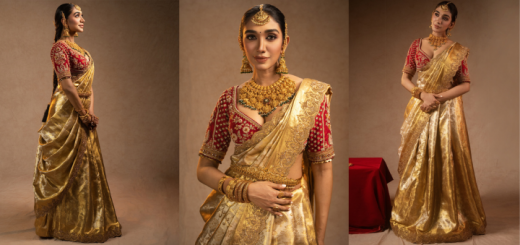
Kanchipuram mulberry silk tends to provide a heavier feel and thicker draping. Classic Kanchipuram sarees made from mulberry silk with zari have a very specific way of being made, which gives them a lot of body. Most traditional Kanchipuram sarees weigh about 600–900 grams, while some luxurious bridal sarees will weigh more. The extra heaviness adds to the overall style of the saree. Because of this, the pleats will be firm and structured, making Kanchipuram perfectly fitted for people who want to wear a stiff outfit instead of one that looks flowy. This feature may also affect comfort through a long event. A heavier Kanchipuram saree may feel heavier on shoulders and waist after being worn for a few hours, especially if the person wearing it is often walking or standing. On the other hand, if the event is not characterized by heavy movements and the focus is on the shapely pleats and defined pallu, then the fabric’s structure becomes an advantage. Overall understanding of its properties should take into account the fact that Kanchipuram does not have as much of a drape as a Banarasi saree, but rather stiffens up with every movement.

Fabric Weight Comparison: What the Numbers Actually Mean
In the comparison of Banarasi and Kanchipuram sarees in terms of long wear, it must be understood that fabric weight is more of a practical metric rather than an indication of quality. The difference of 150-300 grams may not appear to be too significant when reading a product description, but it means different things when a model is wearing. Thus, a saree that weighs 550 grams differs significantly in wearing experience from a saree that weighs around 850 grams after some time of standing, or sitting, or doing something else. Zari is one of the main reasons behind this difference. The saree that has zari woven densely around its body and pallu will weigh more than the saree that has very little zari work. Consequently, cotton sarees made of the same type can have very different long wear characteristics. When ordering your saree online, do not ask for the weight of the product as shown in grams but ask for the actual weight and please ensure that the jacket or packing is not included in the specified weight.


Drape Fluidity: How the Two Silks Move
The key visible difference between the two types of fabric comes to the surface only when the one wearing the sari moves. A moderately-weighted Banarasi fabric makes the pleats and the pallu respond more efficiently to motion, resulting in a soft fall of the fabric. This quality makes Banarasi suitable for events when a person needs to move constantly. Kanchipuram mulberry silk, however, results in a more rigid silhouette. Thanks to its substantial body, the pleats are defined, and the pallu falls flat. In this way, the sari keeps its shape without allowing any room for movement or twisting during a long ceremony. Thus, the wearer experiences two different types of wearing: one using a light Banarasi and the other a heavy Kanchipuram.


Pleat Stiffness: Soft Folds vs. Defined Structure
During a ceremony that can last as long as 12 hours, the role of pleat behavior is especially crucial since the saree experiences a lot of movement. In most cases, Banarasi silk pleats show moderate stiffness. However, this varies depending on the construction method used in processing, density of zari and silk quality. As a result, some silk sarees may appear silkier due to softer pleats. A heavily brocade Banarasi saree will likely exhibit stiffer pleats than a lighter Katan saree. In contrast, Kanchipuram makes stronger matching pleats due to the quality of the silk used. Their distinctive quality allows them to keep their shape and maintain an overall structure in sarees. Those who prefer sharper pleats may find that Kanchipuram suits them best, while those seeking greater ease of movement might prefer the Banarasi.


Wrinkle Resistance: Neither Silk Is Completely Crease-Proof
Another essential issue to deal with is the wrinkle-resistance of each fabric. It is important to point out that Kanchipuram and Banarasi silk should never be considered as totally wrinkle-free materials. This is due to the natural character of silk as a fabric, which means wrinkles can appear after prolonged sitting, moving about as well as applying pressure to the fabric. There is a great distinction between these fabrics in relation to wrinkles, as it is not about the number of wrinkles present in fabrics but more about the ability of the fabric to deal with the appearance of these wrinkles. Kanchipuram silk has a structured design that preserves the beauty of the saree fabric, even though there might appear creases at the waist line and knees. Banarasi fabric may also be creased, but its densely woven patterns may create the impression that there are no creases on the fabric. The presence of humidity and sweating of the person may also impact both fabrics if a ceremony lasts for a long time. It is believed that proper draping, avoidance of extreme folding and correct storage of the saree after wearing it can help to eliminate undesirable creases.


Which One Works for Different 12-Hour Ceremony Conditions?
A saree made of Banarasi fabric with a moderate weight could provide ease of draping while the ceremony requires a lot of movement, standing, or walking on foot. A saree made of light fabric can also help lessen the burden of draping a saree for hours. A saree made of Kanchipuram fabric, on the other hand, could last for a long time in a sitting position without causing discomfort. Kanchipuram provides stiff folds of fabric, while Banarasi fabric is softer with better draping capabilities. In case of preference for strong pleats, go for Kanchipuram which is made of a thicker fabric. In case of preference for lighter fabrics and good draping, trying out the fabric of Banarasi sarees can be a good option. In the case of an occasion where dancing and moving around is involved, the weight of the fabric takes a more important role and should be considered reasonable since both collections have sarees with heavy zari work done on them irrespective of being Kanchipuram or Banarasi.


How to Choose the Right Saree for 12 Hours
Instead of selecting only based on the fabric name, determine the true saree using the four practical parameters of weight, stiffness of pleats, fluidity of draping, and wrinkle-resistance. Tackle the task of weight first by asking for the saree weight and to verify whether the strength of the blouse piece has been taken into account. Then, consider the density of the zari since the use of metallic weaving will increase the total weight significantly. Next, assess the body of the fabric. Stiff fabric is bound to make the pleats sharper, while a more flexible fabric allows for more movement. Finally, think about how the saree will be worn throughout the day. A saree that feels acceptable to wear for two hours may well be uncomfortable after ten or lengthier hours.


Final Takeaway
The Banarasi or Kanchipuram fabric we choose to wear for the next 12-hour ceremony boils down to the inherent performance properties of either variety. While the hand-woven Banarasi silk is more flexible and lightweight even in moderate-weight designs, Kanchipuram mulberry silk tends to be sturdier, with sharper pleats that produce a more structured drape and stiffer structure in general. Hence, neither one can be considered absent of drawbacks. What matters the most is the exact weight in grams, zari density or type of weaver; this kind of stuff carries much more weight than the mere saree type.
Also Read:-
The Hidden Spiritual Meanings Behind Iconic Banarasi Saree Motifs